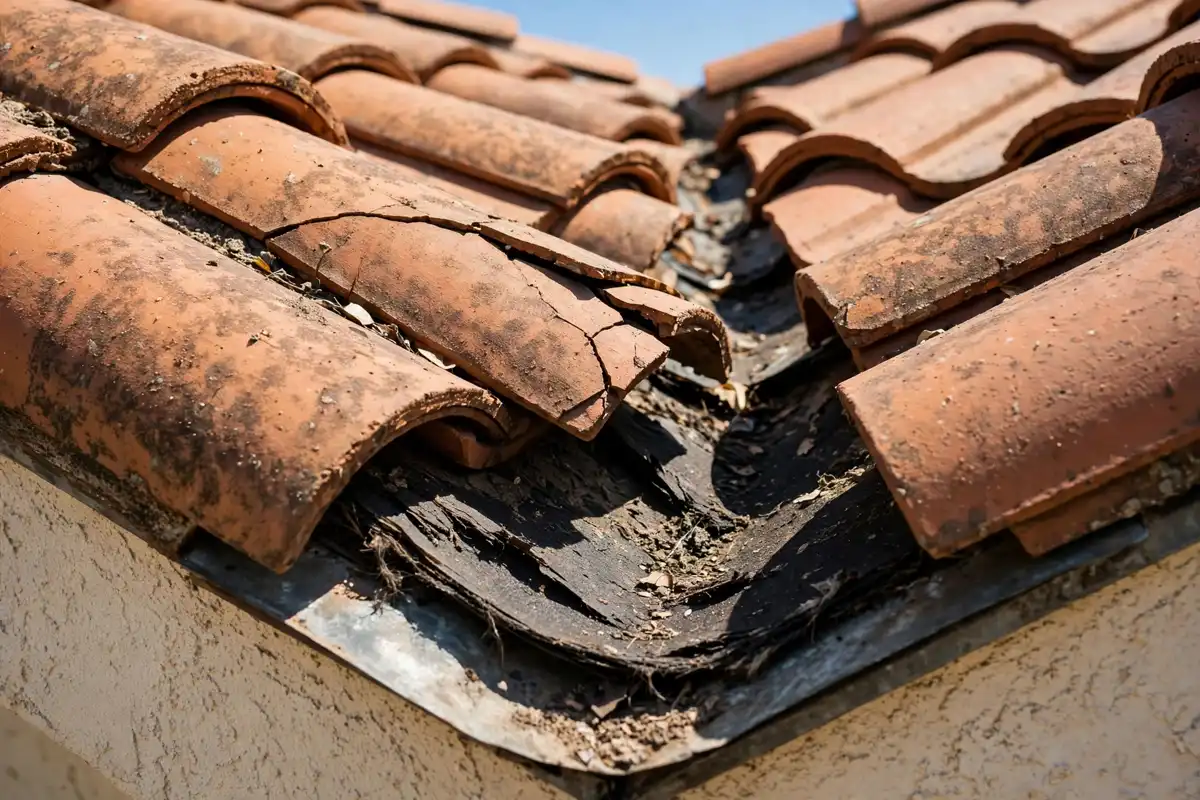
The best roofing materials for hot Woodland Hills summers are clay and concrete tile, standing seam metal, and cool-rated asphalt shingles, in that order for pure heat performance. Tile and metal reflect the most solar radiation, shed heat fastest after sundown, and carry long guide lives under the San Fernando Valley sun. Shingles cost the least upfront and still perform well when they carry a CRRC cool-roof rating. What the rest of this post covers is how each one actually behaves on a Woodland Hills roof, what Los Angeles market bands show, and which one fits your house, your attic, and your budget.
What actually makes a roof work in Woodland Hills heat
Woodland Hills runs hotter than the LA basin on a typical July afternoon, and triple-digit days are routine from late June through September, with hot afternoons lingering into October. That heat load does three things to a roof: it cooks the surface material, it drives heat through the deck into the attic, and it expands and contracts every fastener and flashing detail twice a day.
Best roofing materials for hot summers in Woodland Hills, California is really a question about three properties: solar reflectance (how much sun bounces off), thermal emittance (how fast the roof releases the heat it absorbed), and dimensional stability (how little the material moves as it heats and cools). A material that scores well on all three keeps your attic cooler, your air conditioning runtime shorter, and the roof itself intact for decades.
The state measures the first two through the Cool Roof Rating Council. California's energy code and the City of Los Angeles green building code both set cool-roof values, and the city values are stricter. The value that governs a given re-roof is confirmed at permit stage, so ask for the CRRC listing for the product proposed rather than assuming one number applies everywhere. The products worth buying clear the bar by a wide margin.
How the top roofing materials compare in Woodland Hills
Roofing materials for hot weather that Woodland Hills homeowners actually choose come down to four families, plus one material to rule out. Here is how each one performs when the thermometer sits high for a week straight.
Clay and concrete tile
Tile is the default roof in this part of the Valley for a reason. Clay and concrete both have high mass, so they absorb the afternoon heat slowly and release it slowly after dark. Your attic peaks later and lower than it would under asphalt. Standard tile profiles carry moderate reflectance ratings, and reflective cool-tile finishes rate higher. The catch is weight: tile is heavy, which means some older Woodland Hills homes need a structural check before installation. Pair it with tile roofing in West Hills, California so the underlayment and flashing are specified for tile weight from day one.
Standing seam metal
Metal is the fastest-cooling roof you can put on a house. A cool-coated standing seam panel sheds heat within minutes of sundown and weighs a fraction of tile. Lifespan is 40 to 70 years in industry guides with a painted finish. The one detail that matters in Woodland Hills is the finish. Bare galvanized panels run hotter than a painted cool-roof panel, and a dark painted panel defeats the purpose. For market context, the Los Angeles band for metal is about $7 to $18 per square foot installed in October 2026 guides, not a Generation Roofing price. See metal roofing in West Hills, California for panel options.
Cool-rated asphalt shingles
Architectural shingles with a CRRC-listed cool granule surface are the value play. They reflect substantially more solar energy than a standard dark shingle, and the Los Angeles market band for asphalt is about $5 to $11 per square foot installed in October 2026 guides, not a Generation Roofing price. Lifespan is 20 to 30 years in general guides for cool-rated architectural shingles, shorter than tile or metal, but the upfront savings are real. If your budget is tight and your attic is already well insulated, this is the sensible pick, handled through shingle roofing in West Hills, California.
Reflective roof coatings
An elastomeric or acrylic coating sprayed over an existing flat or low-slope roof is the cheapest way to cut heat gain. A white coating can drop surface temperature substantially on a hot day. It is not a new roof. It buys additional years on a sound substrate. It is the most common heat step discussed for flat roofing in West Hills, California on garages and additions.
Wood shake: not a City of Los Angeles option
Cedar shake looks good on the older ranch homes along the hills, but it is the wrong material for a hot, dry climate, and it is not an approved new covering anywhere in the City of Los Angeles, under LABC section 1504.1. It dries out, cracks, and creates a fire-risk surface. It is therefore not recommended here, and not offered as a new covering option.
Does roof color matter in a hot climate in Woodland Hills CA?
Yes. Colour is the single biggest variable you control on a re-roof. A dark charcoal shingle runs far hotter on a hot afternoon than the same shingle in a cool white or light terracotta granule. That difference translates directly into attic temperature, and attic temperature drives how hard your air conditioning works from afternoon into evening.
The catch is that colour alone is not enough. A white shingle without a cool-rated granule still absorbs more heat than a mid-tone tile with a reflective finish. What matters is the CRRC rating, not the colour name on the sample board. If you want the deep charcoal look, ask for a cool-rated charcoal product. Several manufacturers now make them, and they perform nearly as well as white.
One more thing: colour fades. A dark roof in Woodland Hills loses reflectance faster than the same roof in a cooler climate because UV exposure here is intense. Aged reflectance is what the codes measure, and it is what you should ask about when you compare products.
How to keep your house cool with roofing in Woodland Hills California
The roof is only half the system. The other half is what happens to the heat once it gets past the deck. Here is the order to work in when a homeowner says the upstairs bedrooms are unbearable in August.
- Seal the attic floor. Air sealing around recessed lights, top plates, and plumbing penetrations stops hot attic air from being pulled into the house. This is cheap and it works.
- Add attic insulation. Most older Woodland Hills homes carry less insulation than current California code calls for. Ask for the current code target for your home rather than assuming a single value, since targets vary by assembly. See insulation installation in West Hills, California for what that scope covers.
- Ventilate the attic properly. Without intake at the eaves and exhaust at the ridge, the attic becomes a solar oven. Balance intake and exhaust so air actually moves.
- Choose a cool roof surface. This is where the material choice from the previous section pays off.
Do all four and a Woodland Hills attic that used to run very hot in July will sit much closer to the temperature of the house. That is the difference between an air conditioner that runs continuously and one that cycles.
What roofing material lasts in hot sun in Woodland Hills California?
Clay tile lasts longest, 50 to 75 years in industry guides, because fired clay does not care about UV. Concrete tile is next at 40 to 50 years. Standing seam metal with a painted finish runs 40 to 70 years in industry guides. Cool-rated architectural shingles last 20 to 30 years in general guides, and standard three-tab shingles in full sun here often fail earlier because the asphalt oxidizes and the granules wash off.
Two details shorten any roof's life in this climate. First, south- and west-facing slopes age faster than north slopes because they take the afternoon sun head-on. Second, poor attic ventilation cooks the underside of the deck and accelerates shingle failure from below. If your current roof failed early, ventilation is often part of the reason.
Both factors should be inspected before recommending a replacement, and a homeowner should be told plainly when a roof repair in West Hills, California will buy them more years against when the roof is done.
What to watch out for
Three mistakes show up on almost every hot-climate roof inspected in the Valley.
- Buying on colour instead of rating. A dark roof with a high reflectance rating outperforms a light roof with a low one. Ask for the CRRC listing, not the sample board.
- Skipping the ventilation upgrade. A new cool roof over a sealed, unventilated attic still runs hot. The roof and the attic are one system.
- Letting a contractor reuse old flashing. In Woodland Hills, the flashing and pipe boots fail before the field of the roof does. Reusing them risks an early leak.
One more: do not let anyone talk you into a dark, non-rated shingle because it is cheaper. The saving upfront shows up as higher summer cooling costs.
When to call a professional
Call a professional when you see granule loss in the gutters, when the ceiling stain in the hallway grows after a Santa Ana wind event, or when your air conditioning cannot hold the upstairs comfortable on a hot afternoon. Those are the three signals that the roof is no longer doing its job.
Generation Roofing handles roof inspection in West Hills, California and full replacements across the west Valley. The visit should tell you what the roof needs and give you written figures to compare, and whether a repair gets you through another summer. If you are weighing a full tear-off against a recoat, the numbers should be worked on your actual roof, not a generic estimate.
Frequently Asked Questions
What is the best roofing material for hot summers in Woodland Hills California?
Clay or concrete tile is the best overall choice, with standing seam metal a close second. Both carry high reflectance ratings, shed heat quickly after sundown, and last decades in industry guides. Cool-rated architectural shingles are the best budget option, at the Los Angeles asphalt market band of about $5 to $11 per square foot installed in October 2026 guides.
Does roof color matter in hot climate Woodland Hills CA?
Yes. A dark shingle runs far hotter on a hot day than a cool-rated light surface. But the CRRC rating matters more than the colour name. Cool-rated charcoal products now exist and perform nearly as well as white.
How to keep house cool with roofing Woodland Hills California?
Combine a cool-rated roof surface with attic air sealing, added insulation, and balanced intake-to-exhaust ventilation. Done together, these steps drop a Woodland Hills attic substantially on a July afternoon and cut air conditioning runtime noticeably.
Are cool roofs worth it in Woodland Hills CA?
Yes, if you plan to stay in the home for several years. A cool roof costs more than a standard re-roof upfront, and the extra figure is usually recovered over several summers in lower cooling load, though no saving is promised here.
What roofing material lasts in hot sun Woodland Hills California?
Clay tile lasts longest at 50 to 75 years in industry guides, followed by concrete tile and standing seam metal at 40 to 70 years. Cool-rated architectural shingles last 20 to 30 years in general guides. South- and west-facing slopes age faster than north slopes, so plan accordingly.
Get help with Roofing in West hills
If your Woodland Hills roof is struggling through another hot October, an inspection and a straight answer on what it needs is the next step. Call Generation Roofing at +1 747-335-3331. Generation Roofing, 6711 Vicky Ave, West Hills, CA 91307.