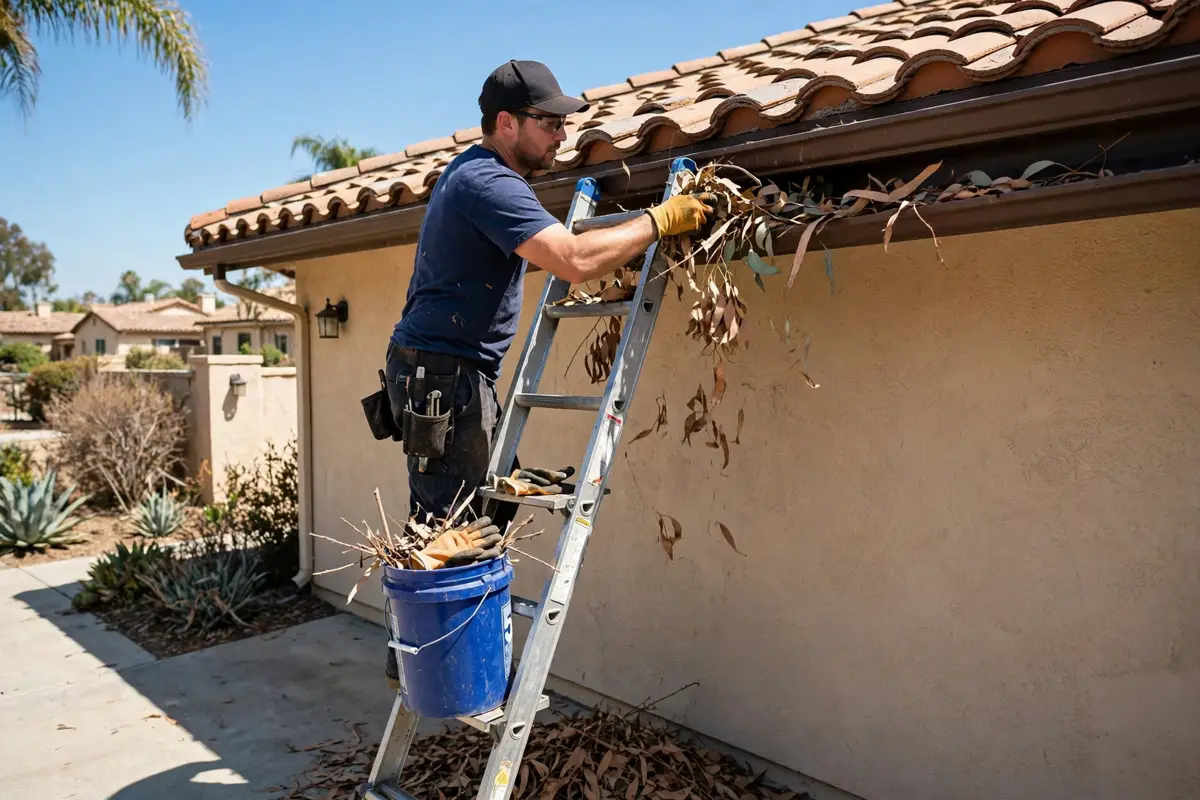
You prepare your roof for rainy season in West Hills by inspecting it in October, cleaning the gutters and downspouts, sealing every penetration and flashing joint, and fixing small leaks before the first storm hits in November. The work is a weekend-scale job for most single-story homes, and it costs far less in effort than the water damage a neglected roof causes in January. This guide walks through a fall checklist, from the ridge line down to the downspout splash blocks.
The damage is rarely dramatic. It is a cracked pipe boot that drips for three months, a gutter full of oak leaves that backs water under the fascia, or a valley that only leaks when the wind pushes rain sideways. None of it is visible from the street. All of it is best found in October.
When is rainy season in West Hills and what it does to your roof
West Hills rainy season runs from November through March, with the heaviest rainfall arriving in December, January, and February. The Los Angeles area averages about 14 to 16 inches of rain per year, and most of it lands in those five months. That means your roof goes from months of dry, hot weather to a stretch where it may see heavy rain week after week.
That swing is what breaks roofs here. Asphalt shingles bake and lose flexibility through the summer, then get hammered by cold water and wind-driven rain. Tile roofs show their weakness at mortar and underlayment. Flat roofs on the valley's many mid-century homes pond water at low spots that never showed a problem in July.
Prepare roof for rainy season in West Hills, California work is really about finding those weak points while the weather is still dry and the repairs are small. Once the storms start, you are patching in the rain.
Start with a roof inspection before the first storm
A roof inspection before rain in West Hills, California should happen in October, and it should cover the whole roof system, not just the shingles. A proper inspection looks at five things: the field of the roof, all flashing and penetrations, the valleys, the gutters and downspouts, and the attic underside.
Here is what to check, in order:
- Shingle or tile condition. Cracked, curled, or missing pieces; exposed nails; granule loss on asphalt.
- Flashing. Chimney, skylight, vent pipe, and wall flashing, plus the step flashing along dormers.
- Valleys and low-slope sections. Rusted metal, torn underlayment, and any spot where water sits.
- Gutters and downspouts. Debris load, sagging, loose hangers, and where the water actually discharges.
- Attic. Staining on the sheathing, damp insulation, and daylight showing through the roof deck.
A professional roof inspection in West Hills should give you photos of every problem and a written priority list. Ask for the report to separate fix now from watch next year, so you are not sold work you do not need.
Clean gutters and downspouts before the rain starts
Gutter cleaning before rainy season in West Hills, California is the single highest-return task on this list, and it is the one most homeowners skip. A clogged gutter does not just overflow. It sends water down the fascia, behind the siding, and into the wall cavity, where it rots framing and shows up as a stain on your ceiling weeks later.
West Hills has a lot of mature oak and sycamore canopy. One large oak can drop enough leaves in November to fill a gutter run. Cleaning gutters twice in the fall is a common pattern: once in mid-October and again after the first big leaf drop in late November.
While you are up there, check three things:
- Downspouts. Run a hose through each one. If water backs up, the spout is blocked, not the gutter.
- Slope. Gutters should pitch about a quarter inch per 10 feet toward the downspout. Standing water means the run is flat or back-pitched.
- Discharge. Downspouts should dump at least 4 feet from the foundation. Short splash blocks that dump right at the wall are a foundation problem waiting to happen.
If your gutters are sagging, leaking at the seams, or undersized for the volume of water your roof sheds, it is worth pricing a replacement before winter. Seamless gutter installation in West Hills, California keeps the water moving and eliminates the seam leaks that show up every February, with runs sized to your roof area.
Seal the leak points that fail every winter
Roof leak prevention in West Hills, California comes down to sealing the handful of spots where most winter leaks start. None of them are the middle of the roof.
The usual suspects:
- Pipe boots. The rubber collar around plumbing vents dries out and cracks with age. A small rubber part can cause large ceiling damage when it fails.
- Chimney flashing. The counter-flashing and cricket are a common leak source on homes with masonry chimneys, and the fix is at the roof joint.
- Skylights. The seal between the glass and the frame fails, and water tracks along the curb.
- Valley metal. Rusted or lifted valley flashing lets water run under the shingles on both sides.
- Nail pops and exposed fasteners. Every exposed nail head is a pinhole leak waiting for a driving rain.
Pipe boots, chimney flashing, and skylight curbs are standard fall prep items. If your skylight is older and already showing condensation or a stain on the shaft, a skylight leak repair in West Hills is usually a reseal and new curb flashing rather than a full replacement.
For flat and low-slope roofs, the prep is different. Ponding water, seam separation, and blisters are the issues, and a reflective roof coating in West Hills, California on a sound membrane is a common October step. It is not a fix for a failed seam or a blister, which need repair first.
Trim trees and clear the roof surface
Tree limbs within 6 feet of the roof are a problem in two ways: they scrape shingles in the wind, and they drop debris that clogs gutters and holds moisture against the roof surface. In West Hills, the biggest offenders are coast live oak, eucalyptus, and Chinese elm.
Trim back any branch that overhangs the roof, and clear the roof surface of leaves, twigs, and seed pods before the first storm. Leaf litter holds moisture against the surface, so clearing it also lets you see the actual condition of the roof.
If you have a tile roof, this is also the time to walk the field and look for slipped or broken tiles. A single displaced tile can let water run straight to the underlayment, and on an older tile roof, the underlayment is the real waterproofing layer, generally reckoned in 20 to 30 years.
Check attic ventilation and insulation before the wet months
Attic ventilation in West Hills matters more in the rainy season than most homeowners realize. A poorly ventilated attic traps warm, moist air, which condenses on the cold underside of the roof deck in December and January. That condensation looks exactly like a roof leak, and it rots sheathing from the inside.
Check for these signs when you are in the attic:
- Dark staining or black speckling on the roof sheathing.
- Damp or compressed insulation, especially near the eaves.
- Rusty nail tips poking through the deck.
- Daylight or water stains around vents and penetrations.
Balanced intake at the eaves and exhaust at the ridge keeps the attic dry. If your home has neither, or if the insulation is matted down from an old leak, paired ventilation and insulation work is the fix to discuss. See attic ventilation in West Hills, California for what that scope covers.
What to watch out for: common mistakes we see in West Hills
The most common mistake is waiting for a leak to appear before doing anything. By the time you see a ceiling stain, water has been running through the roof assembly for weeks, and the repair is no longer just a pipe boot.
Other mistakes seen every fall:
- Pressure-washing the roof. It strips granules off asphalt shingles and drives water under tiles. Use a soft wash or a blower instead.
- Sealing over wet or dirty surfaces. Caulk and roof cement will not bond to a damp surface. Prep work is the whole job.
- Ignoring the second-story roof because you cannot see it. The upper roof sheds onto the lower roof, and that is where the damage shows first.
- Cleaning gutters but not checking downspouts. A blocked downspout turns a clean gutter into an overflow channel.
- Hiring the cheapest quote for a full replacement. A roof replacement in West Hills that skips new underlayment or proper flashing is the classic shortcut that leaks early.
If your inspection turns up a roof that is at the end of its life, it is better to replace it in October than to patch it in January. A full replacement is a multi-day job on a typical home, while patching a failing roof every winter never actually solves the problem.
When to call a professional
Call a professional when you find active water intrusion, when the roof is more than 15 years old, or when the inspection turns up problems on more than one section of the roof. Those are the jobs where a homeowner's weekend patch turns into a bigger repair by February.
A fall prep visit can cover inspection, gutter cleaning, flashing and pipe boot sealing, and a written report of anything that needs attention. If you are not sure whether your roof is storm ready, that visit answers it in an afternoon.
If you are comparing contractors, it helps to know what a good local roofer in West Hills, California actually does on a prep visit. The scope should be visible before you call, as on our Roofing in West Hills, California page.
Frequently Asked Questions
How do I prepare my roof for rainy season in West Hills California?
Inspect the roof in October, clean gutters and downspouts, seal pipe boots and flashing, trim overhanging trees, and check the attic for moisture. The whole checklist prevents the leaks that show up in December and January.
When is rainy season in West Hills CA?
Rainy season in West Hills runs from November through March, with the heaviest rain in December, January, and February. The area averages about 14 to 16 inches of rain per year, and most of it falls in those five months.
What roof maintenance before rain in West Hills California actually matters most?
Gutter and downspout cleaning matters most, followed by sealing pipe boots and chimney flashing. Those items account for the majority of winter leaks, and both are small jobs before the rain starts and large ones after it.
How do I prevent roof leaks in rainy season West Hills CA?
Seal every penetration, replace cracked pipe boots, re-flash the chimney and skylights, and clear debris from valleys and gutters. If the roof is over 15 years old, get a professional inspection in October rather than waiting for a ceiling stain.
Should I clean gutters before rain in West Hills California?
Yes. Clean gutters in mid-October and again after the late-November leaf drop. A clogged gutter sends water behind the fascia and into the walls, which is a far more expensive repair than a gutter cleaning.
Get help with Roofing in West Hills
If you want your roof checked, sealed, and storm ready before the first rain, a fall prep visit is the step to book. Call Generation Roofing at +1 747-335-3331. Generation Roofing, 6711 Vicky Ave, West Hills, CA 91307.