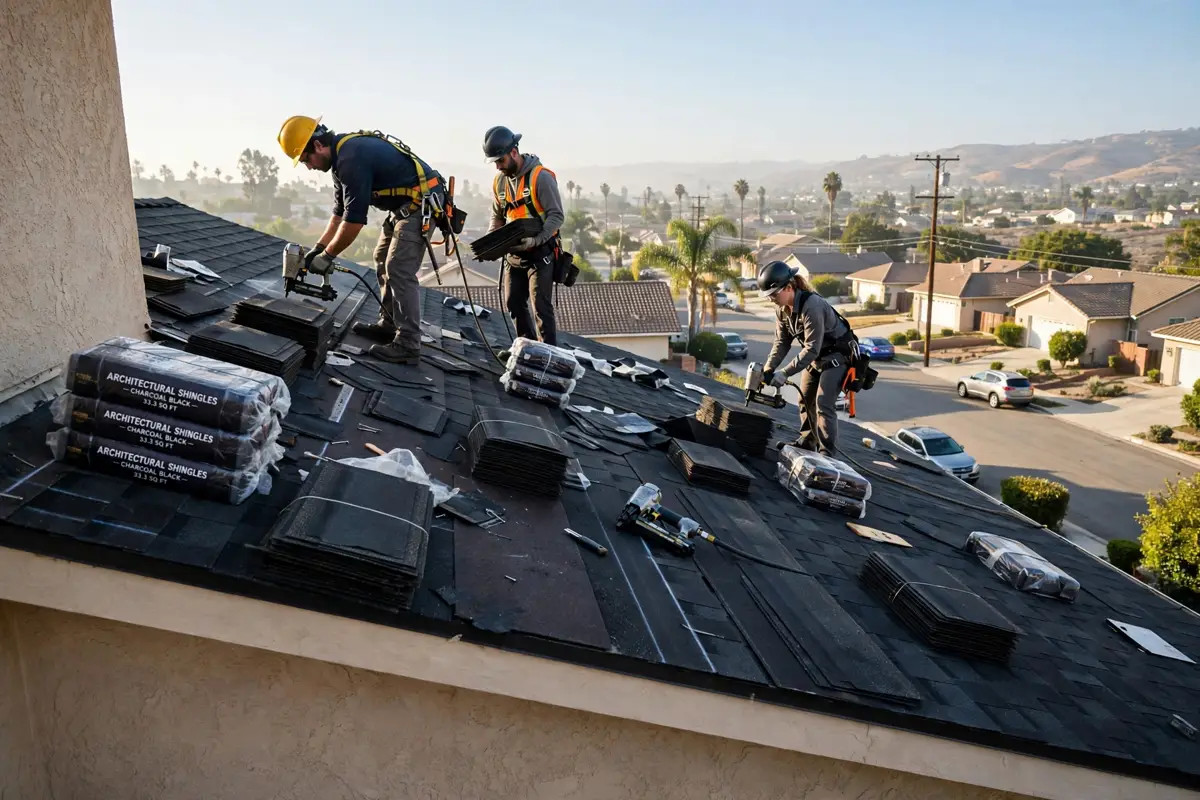
If your roof is young and the damage is isolated to one slope or a few shingles, repair is the natural starting point. If it is older, leaking in more than one spot, or showing granules in the gutters and sagging decking, replacement deserves a serious look. That is the whole decision in outline, and it covers most homes in West Hills, California. The rest of this post breaks down the age picture, the damage signs that actually matter, and the market cost bands that make the call clearer.
The short answer: repair vs. replacement in West Hills
Roof repair or replacement in West Hills, California is a decision that hinges on three things: the age of the roof, how far the damage has spread, and whether the cost of patching it will approach the cost of replacing it. A single cracked flashing boot around a vent pipe is a repair-scale job. Curling shingles across three slopes on an old roof is a replacement discussion.
One useful comparison is the repair figure against a replacement figure for the same roof. When patching approaches replacement cost on an old roof, replacement deserves a closer look. When a small repair buys years on a younger roof, patching is usually the better use of money. Keep a note of each repair and each leak location, because repeated patching on an old roof can quietly add up to more than one replacement would have cost.
West Hills sits in a pocket of the San Fernando Valley where summer heat and afternoon sun age asphalt shingles faster than coastal roofs see, and Santa Ana wind cycles stress tabs and flashing year after year. South and west slopes show wear first, because they take the afternoon sun head-on. A shingle roof here will usually show its age sooner than the same product on a cooler coastal roof.
Start with roof age: how old is too old in West Hills CA?
Roof age and replacement decisions in West Hills, California start with the material, because every roofing type has a different clock. The ranges below are broad, general guide ranges, not promises and not West Hills measurements.
- 3-tab asphalt shingles: generally at the shorter end of the general asphalt range. Many 1990s and early-2000s tract homes in West Hills were built or re-roofed with these.
- Architectural (dimensional) shingles: in the middle of the general asphalt range, and the common current choice for tract re-roofs. General asphalt guides commonly cite roughly 15 to 30 years depending on product and exposure, with Valley heat pushing toward the shorter end.
- Clay and concrete tile: the tile itself can last many decades, but the underlayment beneath it is generally reckoned in 20 to 30 years. The tile outlives the waterproofing under it, which is why tile decisions turn on underlayment condition.
- Standing seam metal: generally reckoned in decades, with industry guides commonly citing 40 to 70 years. Finish, fastening, and detailing matter as much as the panel itself.
- Legacy wood shake and cedar: not an approved new covering anywhere in the City of Los Angeles, under LABC section 1504.1. A surviving shake roof is therefore a replacement-planning item, not a like-for-like re-cover option.
- Heavy coverings such as slate: weight, flashing, and fastener condition decide more than the surface alone. These are specialist roofs, and repair against replacement needs a specialist assessment, not a rule of thumb.
If you do not know the age, check the original build date on your home and any permit history for the current covering. West Hills has a neighbourhood median year built of 1969, so many homes are on a second or third covering. If a roof has not been touched since the 1990s, it deserves a close look, whatever the material.
One more thing about age: a re-roof in California must meet current cool-roof rules, and the City of Los Angeles green building code sets stricter values than the state code. The value that governs a given re-roof is confirmed at permit stage, so ask for the CRRC listing for the product proposed rather than assuming one number applies everywhere.
Signs your roof needs replacement in West Hills
Signs a roof needs replacement in West Hills are the ones that show up in more than one place at the same time. One damaged area is a repair. A pattern across the roof is a replacement discussion.
Here is what to look for:
- Granules in the gutters and at the downspout outlets. If grit is washing off the driveway after every wind event, the shingle surface is wearing thin.
- Curling, cracking, or missing shingles on multiple slopes. Especially on the south and west faces.
- Daylight through the roof deck. Get in the attic on a sunny afternoon. If you can see light between the boards, water has a path in too.
- Sagging roof lines. Stand across the street and look at the ridge. A dip deserves a professional look, because it can mean the decking or framing has taken on moisture.
- Leaks in more than one room or on more than one ceiling. Two separate stains usually mean two separate failures.
- Rust streaks or corrosion on the flashing and vents. Once the metal is compromised, patching it may only be temporary.
If you are seeing three or more of those, get a roof inspection in West Hills, California with photos before deciding. An inspection separates a repair from a replacement with evidence, rather than leaving the call to a sales conversation.
Roof damage signs in West Hills that still mean repair
Roof damage signs in West Hills that still mean repair are the ones that do not actually require a new roof. A leak is not the same thing as a worn-out roof. Most leaks trace to a small number of places:
- Failed pipe boots and vent flashing. The rubber collar around a plumbing vent cracks after years of UV exposure. That is a localized repair, not a replacement.
- Chimney flashing. The counter-flashing at the chimney is a common leak point on a West Hills roof, and it is a flashing and sealing job at the roof joint.
- Valley and step flashing. Where two roof planes meet, the metal takes the full flow of water. It can fail before the shingles do.
- Nail pops and lifted shingle tabs. A handful of lifted tabs after a Santa Ana wind event is a repair-scale job.
If the shingles around the damaged area are still pliable, still have their granules, and the deck underneath is solid, repair is the right call. Attic ventilation matters here too, because a hot, poorly vented attic cooks the shingles from underneath and shortens the life of the whole roof. That is why a repair is often considered alongside attic ventilation in West Hills, California, which can add years to a roof that is otherwise healthy.
One local note: the older ranch homes on the west side of the neighbourhood, closer to Bell Canyon and the hills, tend to face more wind-driven flashing damage than the homes on the flatter streets near Fallbrook. Same age, different failure pattern. That is why an on-roof look matters before any figure is discussed.
Roof replacement vs. repair cost in West Hills California
Roof replacement against repair cost in West Hills, California is where the decision usually becomes clearer. The figures below are Los Angeles market bands from October 2026 guides, not a Generation Roofing price, and sources disagree within them:
- Small repair (flashing, pipe boot, a few shingles): the lowest-cost work. For market context only, Angi reported a Los Angeles average repair figure of $1,883 on 12 August 2025, with most projects between $721 and $3,169.
- Mid-size repair (a full slope, valley repair, chimney flashing rebuild): above a single-point fix and below a re-roof. The figure depends on the area involved, the material lifted and reset, and the access.
- Full architectural shingle replacement: the Los Angeles market band for asphalt is about $5 to $11 per square foot installed, measured on roof surface rather than floor area.
- Tile re-roof (new underlayment under existing tile): the Los Angeles market band for tile is about $10 to $22 per square foot installed. Where sound tiles are reused over new underlayment, Los Angeles guides report lift-and-relay around $12,000 to $30,000 for a typical job, as market data only and only where the tiles are reusable.
- Metal roof replacement: the Los Angeles market band for metal is about $7 to $18 per square foot installed, with standing seam toward the upper part of that band in most guides.
Tear-off can reveal rotted sheathing, which is common on roofs that have leaked quietly for a few seasons. Ask how deck replacement is priced in writing before work starts, and ask the same about gutters if they come off during a full replacement.
The comparison is straightforward. If a small repair buys years on a younger roof, do it. If a large repair on an old roof approaches the replacement figure for the same roof, put the money toward the replacement instead. When that is the call, roof replacement in West Hills, California should be scoped in writing, including tear-off, underlayment, flashing, and haul-away, so the two options can be compared fairly.
What to watch out for: common mistakes homeowners make
The most expensive mistake is patching a roof that is already past its service life. Money spent in October, then again in January, can add up to a large share of a replacement on a roof that is still leaking.
Other ones to watch for:
- Judging the roof from the ground. You cannot see flashing, deck condition, or underlayment from the driveway. The real problems are under the surface.
- Ignoring attic evidence. Stained rafters, damp insulation, and rusted nail tips tell you more than the shingles do.
- Hiring the lowest bid with no tear-off discussion. A roof-over saves money up front and traps moisture between layers. It can also affect manufacturer terms, so ask how an overlay is treated, in writing.
- Waiting for the rainy season. In West Hills, the rain window runs November through March. A fall check leaves time to plan, while a January leak leaves little room to compare options.
- Skipping the permit. A full re-roof in the City of Los Angeles is a permitted job, and permit responsibility should be confirmed in writing. Unpermitted work becomes a disclosure problem when you sell.
If you want to get ahead of the season, the time to look at the roof is in the fall, before the first storm. A roof maintenance in West Hills, California visit in October catches the small stuff, including lifted flashing, clogged valleys, and cracked sealant, while it is still a small job.
When to call a professional
Call a professional when you see water inside the house, when the roof is older and you are not sure what you are looking at, or when a repair figure starts to look like a large share of a replacement. Those are the three moments where a professional opinion saves real money.
Generation Roofing works in West Hills and the surrounding Valley neighbourhoods. An inspection covers the roof, the attic, and the drainage, and the scope should be given in writing before any work starts, repair or replacement, so the homeowner can decide without pressure.
If you are comparing contractors, it helps to know what a full scope includes against a crew that only handles tear-offs. Ask for the licence number in writing, check it on the CSLB Check A License service, and confirm permit and insurance details in writing. You can compare scopes on our roofer in West Hills, CA page.
Frequently Asked Questions
How do I know if my roof needs repair or replacement in West Hills California?
If the roof is young and the damage is in one area, repair it. If it is older, leaking in multiple spots, or the repair figure is approaching a replacement figure for the same roof, replace it. Age plus damage spread is the whole test.
What are signs of roof damage in West Hills CA?
Granules in the gutters, curling or missing shingles, daylight visible through the attic deck, sagging roof lines, rusted flashing, and ceiling stains in more than one room. Any two of those together are worth a professional look before the rain season starts.
Can a roof be repaired instead of replaced in West Hills California?
Yes, most of the time. Failed pipe boots, chimney flashing, valley metal, and a handful of lifted shingles are all repair-scale jobs when the shingles are still pliable and the deck is solid.
How long does a roof last in West Hills CA?
Only in broad, general ranges, because every roof ages differently. General guides cite roughly 15 to 30 years for asphalt, decades for tile with underlayment generally reckoned in 20 to 30 years, and 40 to 70 years for metal in industry guides. Valley heat shortens all of those on south-facing slopes.
Should I repair or replace my roof in West Hills California?
Repair if the roof is young and the damage is isolated. Replace if it is older, if leaks have shown up in more than one place, or if the repair figure approaches a replacement figure for the same roof. That is where patching stops making financial sense.
Get help with Roofing in West Hills
Whether you need a flashing repair or a full tear-off and re-roof before the winter rains, the decision should rest on age, damage spread, and written figures for your roof. Call Generation Roofing at +1 747-335-3331. Generation Roofing, 6711 Vicky Ave, West Hills, CA 91307.