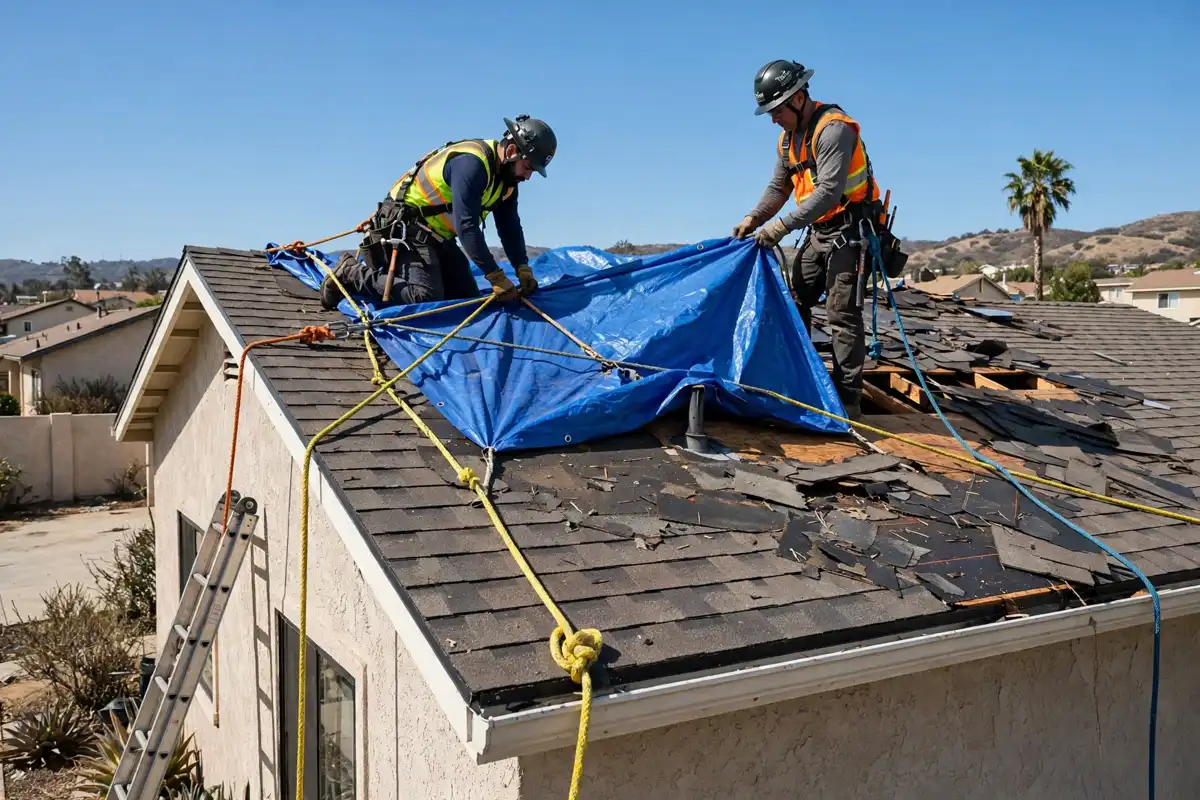
Your roof is leaking after heavy rain in West Hills because water is getting past the outer layers and finding a path through a failed flashing joint, a lifted shingle, a cracked pipe boot, or a clogged drainage edge, and the leak shows up inside only after that water has traveled along the decking. A roof leak after rain in West Hills is rarely a mystery once you know the seven failure points that cause almost every one. Below, each cause is explained, along with what to do while it is still raining, how to slow the water temporarily, and when a repair turns into a replacement discussion.
The leak you see on the ceiling is almost never directly under the hole. Water enters high, runs along a rafter, and drips at the lowest point it can find. That is why guessing from inside the house wastes time, and why the attic, not the stain, is the place to start looking.
Roof leaking after heavy rain in West Hills, California is rain-driven water intrusion: rain volume, wind-driven angle, and one or more aged components line up on the same storm. It is not the same as a slow drip from a plumbing vent. If the stain grows only during and right after rain, the roof is the likely source.
Why does my roof leak when it rains in West Hills California
Your roof leaks when it rains in West Hills, California because the rain arrives with wind and volume that push water sideways and upward into places a gentle shower never reaches. West Hills sits at the western edge of the San Fernando Valley, where winter storms out of the Pacific can drop heavy rain in a few hours and drive rain at a near-horizontal angle. That combination exposes every weak point at once.
Three local factors make it worse. First, summer heat bakes the roof surface for months, drying out sealants and shrinking the mastic around flashings. Second, the wind events that precede the rainy season blow oak and eucalyptus leaf litter into valleys and against chimney crickets. Third, many homes here date from the 1960s tract build-out, with a neighbourhood median year built of 1969, so the original underlayment on an older roof may be past its service life even if the shingles still look intact from the street.
When those three things meet a storm, the roof does not fail everywhere. It fails at the one spot that was already marginal.
The 7 most common roof leak causes in West Hills CA
Common roof leak causes in West Hills, California fall into seven groups, and identifying which one you are dealing with helps you decide whether it is a homeowner-scale fix or a call to a roofer.
1. Failed flashing at walls, valleys, and chimneys
Flashing is the metal that seals the joints where the roof plane meets a vertical surface. Sealant behind it ages in Valley heat, then cracks. Water gets behind the metal, runs down the wall sheathing, and shows up on a ceiling two rooms away from the joint itself.
2. Lifted or missing shingles
A single tab lifted by wind is enough. Once the tab is up, the fastener heads underneath are exposed and water wicks straight through the fastener holes. Heat-aged tabs lift more easily than pliable new ones, which is why a wind event after a long hot summer finds so many.
3. Cracked pipe boots and vent seals
Every plumbing vent and exhaust fan that penetrates the roof has a rubber boot around it. That rubber cooks in the Valley sun and eventually splits. The leak is small and steady, and it often drips down the vent pipe into a bathroom wall.
4. Clogged gutters and backed-up valleys
When gutters fill with leaf litter and grit, water backs up under the bottom row of shingles and into the fascia. This is the leak that shows up as a stain on the exterior wall, not the ceiling. If gutter cleaning in West Hills has not been done in the last year, start there before assuming the roof itself is failing.
5. Worn underlayment under intact shingles
This is the one that fools homeowners. The shingles look fine from the ground, but the felt underneath has dried out and torn. Water passes through the shingle seams and straight through the underlayment. You cannot see this from a ladder. You see it from the attic, where staining and damp sheathing tell the story.
6. Skylight and chimney penetrations
Skylights leak at the curb flashing, not the glass. Chimneys leak at the counter-flashing where the roof meets the masonry. Both are common on West Hills homes with later additions. A skylight repair in West Hills call is usually a flashing job, not a glass replacement, and a chimney leak is usually a flashing and sealing job at the roof joint.
7. Debris dams in valleys and behind chimneys
West Hills does not have a winter ice story, but it does have debris dams. Leaf litter builds up behind chimneys and in roof valleys, and a dam holds water on the roof long enough for it to find a way in. Clearing the debris often stops the leak without any repair at all.
What to do if your roof leaks during a storm in West Hills CA
If your roof leaks during a storm in West Hills, California, your first job is to protect people and property, not to fix the roof. Do these in order.
- Move electronics and furniture out from under the drip. Water and a live outlet are a worse problem than a wet ceiling.
- Put a bucket down and a towel under it. If the ceiling is bulging, poke a small hole in the bulge with a screwdriver to let the water drain in a controlled way. A bulging ceiling that releases on its own dumps far more water at once.
- Do not go on the roof during the storm. Wet shingles and wind are how people get hurt. Wait it out.
- Photograph everything. Ceiling stains, the bucket, and the attic framing if you can reach it safely. Photos help any later insurance conversation.
- Call for emergency help if the leak is near a light fixture or a panel, or is spreading fast. Treat that as urgent, not as a call to leave until Monday.
If water is coming through a light fixture or pooling near wiring, shut off the breaker for that room and call for emergency roof repair in West Hills help. Do not touch a wet switch or fixture while the power is on.
How to temporarily fix a roof leak in West Hills California
To temporarily slow a roof leak in West Hills, California, wait for the rain to stop, then apply a peel-and-stick patch over the suspected entry point from a stable ladder. This buys you time, not a repair. Here is the sequence to follow.
- Find the entry point from the attic, not the ceiling stain. Look for water tracks on the rafters and sheathing. The highest wet spot is your target.
- Dry the area. A patch will not stick to a wet surface. Use a rag and give it time to dry.
- Apply roofing cement and a strip of mesh or flashing tape. Press it down hard and overlap the edges well.
- Do not seal the whole roof. You will trap moisture and create a bigger problem. Patch the one spot.
- Mark the calendar. A temporary patch is short-lived in Valley heat and sun, which lift its edges. Plan a proper repair rather than relying on it through another season.
If you are not comfortable on a ladder, or the roof pitch is steep, do not attempt it. A fall costs more than a service call. This is also the point where many homeowners decide to get a real roof leak repair in West Hills rather than keep patching the same spot every season.
What to watch out for after the rain stops
The damage from a rain leak often shows up days after the storm passes. Watch for these signs.
- Sagging ceiling or bubbling paint. That is trapped water. It will not dry on its own.
- Musty smell in the attic or a bedroom. A damp smell can mean trapped moisture that needs to be found and dried.
- Soft spots in the ceiling near the stain. If the drywall gives under gentle pressure, the ceiling material is compromised.
- Rust on nail heads in the attic. That tells you water has been getting in longer than you thought.
- A second leak in a different spot after the next storm. That is the pattern of an aging roof, not a one-off.
If you see any of these, get a roof inspection in West Hills before the next rain. An inspection that finds several weak points early is far cheaper than separate emergency calls through the winter.
When to call a professional
Call a professional when the leak returns after a patch, when water is near electrical fixtures, or when you cannot find the entry point from the attic. Those three situations are beyond a homeowner fix. Leaks in a valley, around a chimney, or under a skylight also need new metal and proper flashing, not more sealant.
At Generation Roofing, a leak visit covers the roof surface, the attic, and the drainage, and you can see the local scope on our Roofing in West Hills, California page. If the roof is past the point where a repair makes sense, that should be shown to you with photos, not asserted. Ask any roofer to show you the failure point and the finished repair.
One more thing worth saying: a leak does not automatically mean a new roof. Roofs are replaced when the decking or the majority of the surface is gone. They are repaired when the failure is localized. Most leak calls end in a repair, and the ones that do not should come with clear evidence why.
What roof leak repair costs in West Hills in 2026
No firm price is quoted here, and no figure in this section is a Generation Roofing price. For market context only, Angi reported a Los Angeles average repair figure of $1,883 on 12 August 2025, with most projects between $721 and $3,169. That is a wide range, and a single leak repair can sit well outside it. Your own figure depends on the failure point, the material, and the access, which is why a written scope for your roof matters more than any published average.
What moves a repair figure up: height, pitch, tile that has to be lifted and reset, and whether the leak is in a valley or at a chimney. What keeps it down: a single pipe boot, a flashing reseal, or a debris dam that just needs clearing.
Before any work starts, ask for the scope and the price in writing. If opening the roof reveals something an inspection could not see, ask the roofer to show you before continuing, and to put the change in writing.
Frequently Asked Questions
Why does my roof leak when it rains in West Hills California?
Your roof leaks because rain is getting past a failed flashing joint, a lifted shingle, a cracked pipe boot, or worn underlayment. Wind-driven rain in West Hills pushes water sideways into joints that a gentle shower never reaches. The leak shows up inside after the water travels along the decking to a low point.
What to do if roof leaks during storm in West Hills CA?
Move electronics and furniture out of the way, put a bucket under the drip, and do not go on the roof during the storm. If the ceiling is bulging, poke a small drain hole. Photograph everything, then call for emergency help if water is near wiring or spreading fast.
How to temporarily fix roof leak in West Hills California?
Wait for the rain to stop, find the entry point from the attic, dry the area, and apply roofing cement with mesh or flashing tape over the spot. A temporary patch is short-lived in this climate. Do not seal the whole roof, or you will trap moisture.
Does roof leak always mean roof replacement in West Hills CA?
No. Most leaks in West Hills are localized failures at flashing, pipe boots, or valleys. Replacement is a discussion for when the decking is compromised or the majority of the roof surface has failed, and it should be backed by photos.
Who to call for roof leak in West Hills California?
Check any contractor on the CSLB Check A License service, ask for the licence number in writing, and confirm permit and insurance details in writing before work starts. Generation Roofing handles leak detection and repair in West Hills. Call +1 747-335-3331.
Get help with Roofing in West hills
If your roof is leaking after heavy rain in West Hills, the next step is a roof-surface and attic check to find the entry point, not the stain. A written scope before work starts lets you compare like with like.
Call Generation Roofing at +1 747-335-3331 for roof leak repair in West Hills, California. Generation Roofing, 6711 Vicky Ave, West Hills, CA 91307.